
The Complete Guide to Custom Millwork: Types, Materials, Styles & Costs
Walk into any high-end Toronto home and the first thing you’ll notice isn’t the paint colour or the furniture — it’s the trim. Crown moulding tracing the ceiling line, clean baseboards grounding every room, casing that frames doors and windows with precision. This is custom millwork, and it’s one of the fastest ways to take a builder-grade home and make it feel custom-built.
This custom millwork guide covers everything homeowners across Vaughan, Woodbridge, and the wider GTA need to know before starting a millwork project: the different types of trim, how to choose materials and profiles, what drives cost, and what a professional installation actually involves.
Table of contest:
- What is custom millwork?
- Types of interior millwork
- Profiles and proportions
- Materials compared
- Room-by-room recommendations
- Modern vs. traditional homes
- What drives costs in Toronto
- The professional installation process
- Common problems and mistakes
- Maintenance and repainting
- Millwork and resale value
What Is Custom Millwork?
“Millwork” refers to any finished wood detailing produced for interior use — historically milled in a woodshop, hence the name. Custom millwork means that detailing is measured, cut, and fitted to a specific home’s actual dimensions, rather than installed from prefabricated, one-size-fits-all trim.
This distinction matters more than it sounds. Older Toronto and GTA homes rarely have perfectly square walls or level ceiling lines, and prefab trim exposes every one of those imperfections with visible gaps and uneven joints. Custom-fitted millwork is scribed and coped to the room it’s going into, which is why the finished result reads as seamless rather than “added on.”
Types of Interior Millwork
Custom millwork covers several distinct categories of trim, each serving a different visual and functional purpose.
Crown Moulding
Decorative trim installed at the junction of wall and ceiling. Crown moulding is the single highest-impact millwork upgrade for perceived ceiling height and overall room finish — see the dedicated breakdown on Crown Moulding Installation in Toronto.
Baseboards
Trim running along the base of interior walls, covering the joint between wall and floor and protecting drywall from scuffs and impact. Baseboard height and profile should generally scale with ceiling height — taller ceilings can support taller, more substantial baseboards. Full details on Baseboard Installation & Replacement.
Door and Window Casing
Trim framing the perimeter of doors and windows. Casing style is usually matched to baseboard style for visual consistency throughout a room. See Door & Window Casing Installation.
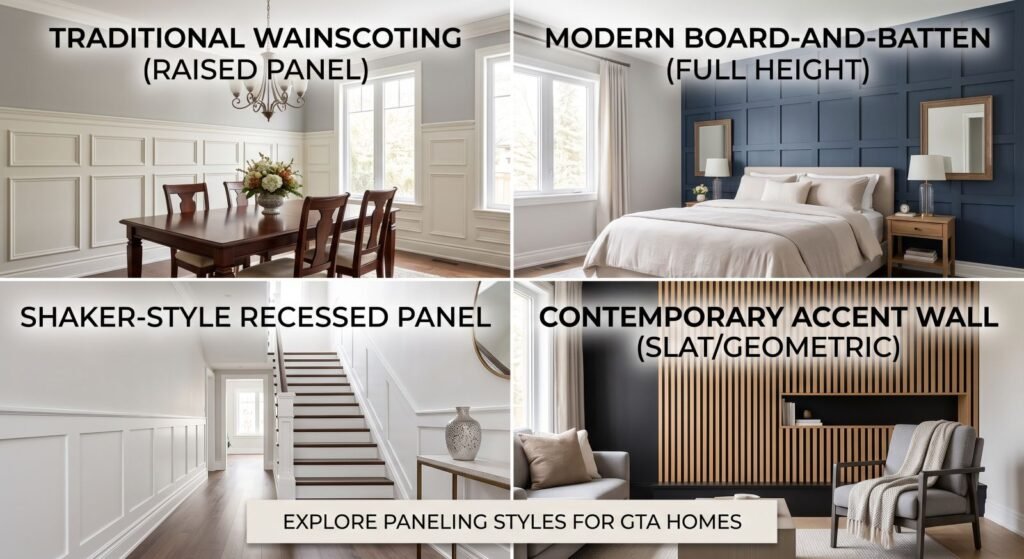
Chair Rail and Wall Panelling
Horizontal trim installed partway up a wall — traditionally at chair-back height, hence the name — often paired with wainscoting, board-and-batten, or picture-frame panelling below it. This category overlaps directly with Flagman’s Wall Features & Panelling service; see Chair Rail & Wall Panelling.
Built-Ins and Custom Architectural Details
Beyond standard trim, custom millwork extends to built-in shelving, media wall surrounds, and other architectural carpentry elements that are designed and fitted specifically for a room rather than purchased off the shelf.
Choosing the Right Profile and Proportions
Profile selection is where custom millwork succeeds or fails visually. A heavy, ornate crown profile can overwhelm a small room, while an undersized profile disappears in a large one and fails to deliver the height and framing effect that makes crown moulding worthwhile in the first place.
General ceiling-height guidance:
- 8-foot ceilings — Lower-profile crown mouldings (roughly 3–4 inches) tend to read as proportionate without visually lowering the room.
- 9-foot ceilings — A mid-range profile (roughly 4–6 inches) gives enough presence to be noticed without overwhelming the wall.
- 10-foot-plus ceilings — Larger, often multi-piece or layered crown profiles (6 inches and up) fill the additional vertical space and prevent the ceiling from feeling disconnected from the walls.
These are general starting points, not fixed rules — room width, natural light, and existing architectural detail all factor into the right proportion for a specific space. A full breakdown by ceiling height is covered in Best Crown Moulding for 8-, 9- and 10-Foot Ceilings.
Millwork Materials Compared
Material choice affects cost, finish, and where trim can be installed.
Primed MDF (Medium-Density Fibreboard) The most common choice for painted millwork. Cost-effective, arrives primed and paint-ready, and machines cleanly into detailed profiles. Not recommended for high-moisture areas without a moisture-resistant variant, since standard MDF can swell if repeatedly exposed to humidity.
Solid Wood Offers a premium look and feel, and takes stain as well as paint — an option MDF doesn’t support. Costs more than MDF and is more prone to natural movement (minor expansion and contraction) with seasonal humidity changes, which can be managed with proper installation and finishing.
Polyurethane Moisture- and rot-resistant, making it the preferred choice for bathrooms, basements, and other high-humidity environments. Lightweight and dimensionally stable, though it comes at a higher material cost than MDF.
A direct side-by-side is covered in MDF vs. Wood vs. Polyurethane Trim.
Custom Millwork Guide: Materials Compared
Material choice affects cost, finish, and where trim can be installed — the next key decision in this custom millwork guide.
Primed MDF (Medium-Density Fibreboard) The most common choice for painted millwork. Cost-effective, arrives primed and paint-ready, and machines cleanly into detailed profiles. Not recommended for high-moisture areas without a moisture-resistant variant, since standard MDF can swell if repeatedly exposed to humidity.
Solid Wood Offers a premium look and feel, and takes stain as well as paint — an option MDF doesn’t support. Costs more than MDF and is more prone to natural movement (minor expansion and contraction) with seasonal humidity changes, which can be managed with proper installation and finishing.
Polyurethane Moisture- and rot-resistant, making it the preferred choice for bathrooms, basements, and other high-humidity environments. Ontario’s permit guidance doesn’t regulate decorative trim, but material choice in wet areas still matters for long-term durability. Lightweight and dimensionally stable, though it comes at a higher material cost than MDF.
A direct side-by-side is covered in MDF vs. Wood vs. Polyurethane Trim.
Not sure where to start? Flagman Construction offers free estimates across Vaughan, Woodbridge, and the GTA — no obligation.
Room-by-Room Recommendations
Not every room calls for the same millwork treatment.
Living and dining rooms — Typically the best candidates for the most detailed millwork package: crown moulding, upgraded baseboards, casing, and in many cases chair rail or wall panelling, since these are the rooms guests see most.
Kitchens — Crown moulding often extends onto upper cabinetry to create a built-in look, alongside standard wall and ceiling trim.
Bathrooms and basements — Moisture-resistant materials (polyurethane, or properly sealed and primed MDF) are typically recommended over solid wood, given ongoing humidity exposure.
Bedrooms — Often a simpler, more restrained profile than main living areas, prioritizing clean lines over ornate detail.
Hallways and stairwells — Baseboard and casing consistency matters most here, since these spaces connect every other room and any mismatch in profile or paint finish is immediately noticeable.
Custom Millwork for Modern vs. Traditional Homes
Millwork isn’t exclusively a traditional-home upgrade. The style of profile chosen determines whether the finished look reads as classic or contemporary.
Traditional homes typically pair well with layered, multi-step crown profiles, dentil detailing, and more substantial baseboard heights that echo period architectural detail.
Modern and minimalist homes are increasingly finished with simple, low-profile crown and baseboard designs — sometimes a clean square-edge reveal rather than an ornate profile — that add architectural definition without visual clutter. This approach has grown in popularity across newer GTA builds and condo renovations where a cleaner aesthetic is the priority.
The right approach depends on the home’s existing architecture, not a fixed rule about “old vs. new.”
What Drives Custom Millwork Costs in Toronto
Millwork pricing varies project to project, but this custom millwork guide covers the factors that consistently influence the final cost:
- Material choice — MDF, solid wood, and polyurethane sit at different price points, as outlined above.
- Profile complexity — Simple single-piece profiles cost less to source and install than layered, multi-piece, or custom-milled profiles.
- Room count and linear footage — Cost scales with the total length of trim being installed, not just room count, so ceiling height and room dimensions both matter.
- Existing wall and ceiling condition — Out-of-square walls, uneven ceiling lines, or existing damage that needs repair before installation can add labour time.
- Painting and finishing — Whether trim needs to be primed, caulked, filled, and painted on-site versus arriving pre-finished affects total project scope.
- Accessibility — Vaulted ceilings, stairwells, and other hard-to-reach areas require more time and specialized approaches than standard flat-ceiling rooms.
Because these variables shift so much from project to project, an accurate cost estimate requires an on-site assessment rather than a flat per-foot number. For a detailed breakdown, see How Much Does Custom Millwork Cost in Toronto?.
The Professional Installation Process
A proper custom millwork installation is not a weekend DIY project — particularly in older homes where wall and ceiling lines are rarely perfectly straight. A professional process generally follows these stages:
1. On-site assessment. A contractor measures actual room dimensions, ceiling height, and wall condition — not just square footage from a floor plan.
2. Profile and material selection. Based on ceiling height, room proportions, moisture exposure, and the home’s overall style.
3. Precision cutting and coping. Corners are coped or mitred to account for out-of-square walls — a hallmark of skilled trim carpentry versus a rushed job that leaves visible gaps.
4. Installation. Trim is secured using appropriate fasteners and adhesives for the material and substrate.
5. Finishing. Caulking, filling nail holes, sanding, and painting (or staining, for solid wood) to produce a seamless, factory-finish look.
Project scope and site conditions vary enough between homes that a specific completion timeline is best confirmed after an on-site assessment rather than estimated in advance.
Common Installation Problems and Mistakes
Several issues come up repeatedly with rushed or DIY millwork installations:
- Visible gaps at corners from mitred (rather than coped) joints on out-of-square walls
- Inconsistent profile scale — trim that’s too small or too large for the room, which undercuts the intended effect
- Poor caulking and filling, leaving nail holes and seams visible after painting
- Mismatched profiles between rooms, particularly noticeable in open-concept layouts and hallways
- Skipping moisture-appropriate materials in bathrooms or basements, leading to swelling or warping over time
Most of these issues trace back to skipping the on-site assessment step and treating installation as a generic, one-size-fits-all task rather than a room-specific fit.
Maintenance and Repainting
Custom millwork is low-maintenance once installed. Painted trim (MDF or polyurethane) generally only needs occasional cleaning and touch-up paint where scuffs occur, most often along baseboards in high-traffic areas. Solid wood trim benefits from monitoring for any seasonal movement at joints, with caulking touch-ups as needed. A full repaint is typically only necessary when updating a room’s colour scheme rather than for maintenance reasons.
Millwork and Resale Value
Millwork is consistently cited as one of the higher-return interior upgrades a homeowner can make, particularly in the GTA’s competitive resale market. Real estate agents and stagers point to trim work — crown moulding, upgraded baseboards, and door casing — as a relatively contained improvement that photographs well and reads as move-in-ready to buyers. Compared to a full renovation, millwork upgrades typically involve far less disruption to daily life in the home while still meaningfully changing how each room presents.
Flagman Construction Projects
Flagman Construction has installed custom millwork across a range of GTA homes, from traditional crown and baseboard packages in Forest Hill and Yorkville properties to clean, minimalist profiles in modern Vaughan and King City builds. Browse completed projects — including coffered ceilings, wall panelling, and full-room trim packages — in the Portfolio Gallery.
Why Choose Flagman Construction for Custom Millwork
Flagman Construction handles custom millwork as part of a full-scope interior finishing practice — from initial profile and material selection through final paint-ready finish, with precision craftsmanship applied consistently across every room. We serve homeowners across Toronto and the GTA, including Woodbridge, Milton, King City, Aurora, Yorkville, and Forest Hill.
Ready to plan your home’s millwork? Contact Flagman Construction for a free consultation.